At first glance, Parc de la Ciutadella seems like the perfect place to escape the busy streets of Barcelona.
Locals come here to relax beneath the trees, enjoy a picnic or spend a sunny afternoon with friends. But this park stands on the site of a former military fortress, and beyond its peaceful gardens, it hides some remarkable architectural treasures and a few unexpected surprises.
If you’ve already walked from the Arc de Triomf to the park, there’s still plenty more to discover.
Let’s take a closer look.
The Cascada Monumental: A Touch of Grandeur
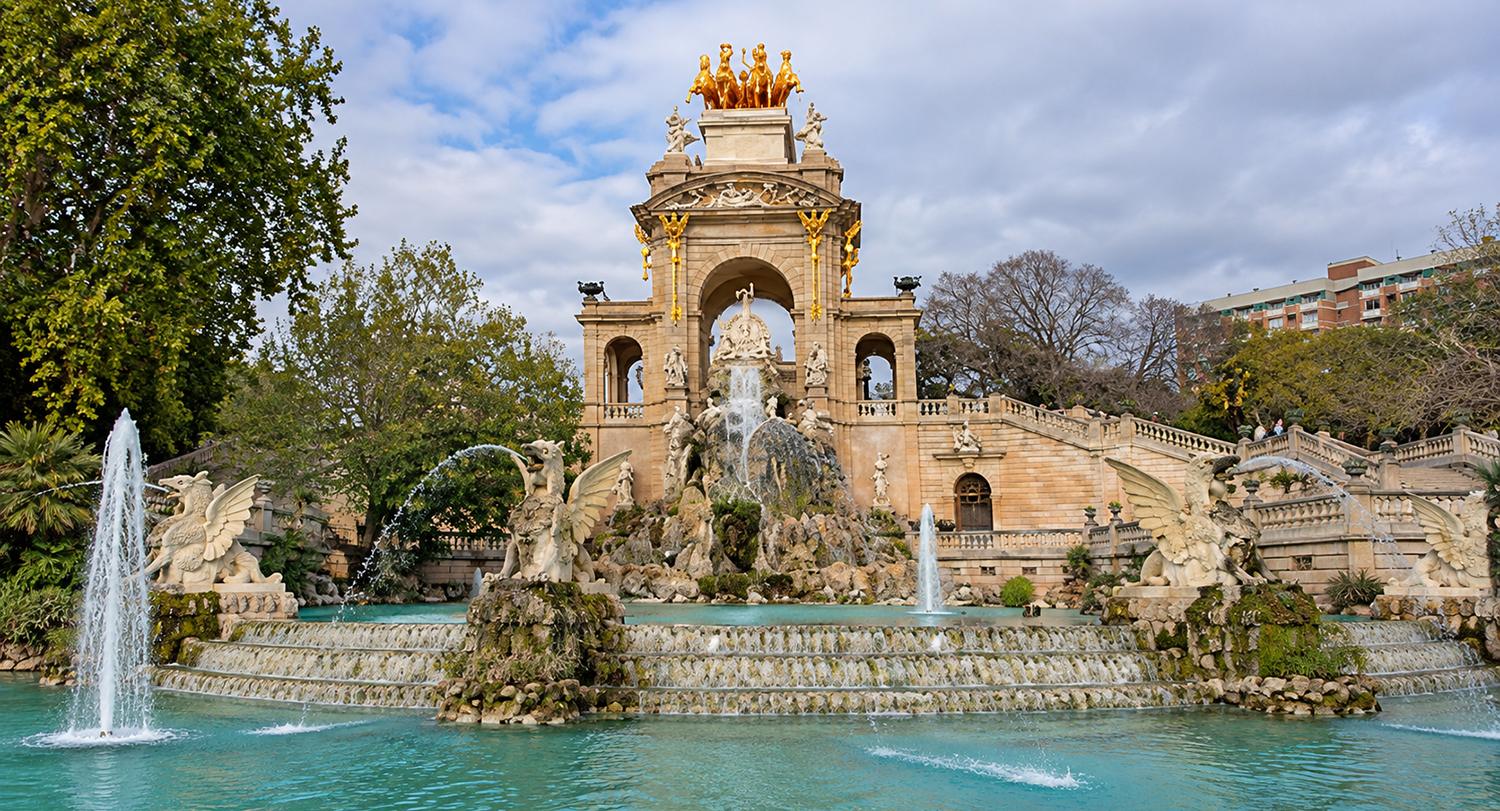
It’s difficult to miss the Cascada Monumental, one of the most spectacular corners of the park.
Designed by Josep Fontserè, this impressive fountain combines grand staircases, sculptures, decorative rocks and a golden chariot sculpture, the Quadriga de l’Aurora, crowning the structure. At its centre, you’ll find the sculptural group depicting the Birth of Venus.
But here’s a detail you might not know: a young Antoni Gaudí, still an architecture student, contributed to the fountain’s hydraulic system and artificial grotto.
Long before his extraordinary work on the Sagrada Família, Gaudí was already involved in shaping Barcelona’s public spaces.
Take a moment to admire the fountain from different angles. There’s much more to discover than you might notice at first.
Castell dels Tres Dragons: A Castle with an Unexpected Purpose
With its red-brick walls, towers and medieval appearance, the Castell dels Tres Dragons looks like something from a storybook.
But it wasn’t built as a castle.
Architect Lluís Domènech i Montaner, who would later create the magnificent Palau de la Música Catalana, designed it as a café-restaurant for the 1888 Universal Exhibition.
The project faced delays, and Domènech i Montaner eventually stepped away before the building was fully completed.
Its combination of exposed brick, decorative ceramics and innovative structural elements makes it an important example of early Catalan Modernisme.
And although its name means Castle of the Three Dragons, its original purpose was much more ordinary: a place where visitors to the Exhibition could eat and socialise.
The building has also been the subject of restoration plans aimed at preserving its architecture and giving it a renewed role in Barcelona’s scientific and cultural life.
Sometimes, appearances can be deceiving.
The Hivernacle: An Elegant Greenhouse of Iron and Glass
Just a short distance from the Castell dels Tres Dragons stands one of the park’s most beautiful and often overlooked buildings.
The Hivernacle, designed by Josep Amargós i Samaranch, is a nineteenth-century greenhouse built with an elegant structure of iron and glass.
It was originally conceived for tropical plants, although it also served as a venue for gatherings and conferences during the 1888 Universal Exhibition.
Its delicate metalwork and generous glass surfaces are a wonderful example of an era when architecture, engineering and nature were coming together in new ways.
After many years closed to the public, the Hivernacle reopened in December 2023 following an extensive restoration. The restoration also brought renewed attention to its decorative work by Alexandre de Riquer, an important artist of Catalan Modernisme.
Today, it shelters a rich collection of plants. It’s one of those places where you might arrive expecting to admire a few plants and end up fascinated by the building itself.
The Umbracle: A Cathedral of Plants
If the Hivernacle is all about light and glass, the nearby Umbracle offers a different way of experiencing nature.
Designed to shelter plants that need shade, this historic structure uses wooden slats to filter sunlight and create a cooler, more protected environment.
Some of the plants inside have grown taller than ten metres, giving the space an almost cathedral-like atmosphere.
Originally conceived as part of Josep Fontserè’s vision for the park, the Umbracle was later completed and adapted by Josep Amargós.
Together, the Hivernacle and the Umbracle reveal another side of the nineteenth-century park: its interest in botany, science and the natural world.
They’re a reminder that the Ciutadella was designed not only as a place for leisure, but also for discovery.
The Mammoth: A Prehistoric Surprise
Finally, not far from the Cascada, you’ll find something rather unexpected: a life-size mammoth.
Created by sculptor Miquel Dalmau in 1907, it was intended to form part of an ambitious project featuring replicas of prehistoric animals.
The plan was never completed, and the mammoth became its only realised sculpture.
More than a century later, it remains one of the park’s most unusual attractions, especially popular with children and curious visitors.
It’s certainly not something you’d expect to encounter during a peaceful walk through Barcelona.
More Than Just a Park
Parc de la Ciutadella is much more than a green space in the centre of Barcelona.
It’s a place where nineteenth-century architecture, artistic ambition, scientific curiosity and everyday life come together.
You might visit for the gardens or the famous fountain, but it’s often the unexpected details that stay with you: a greenhouse full of history, a castle that was never really a castle or a prehistoric mammoth standing among the trees.
Would you like to discover these stories with a local guide? Get in touch with us and we’ll be happy to organise a personalised experience around Barcelona.
I hope you’ve enjoyed discovering the hidden treasures of Parc de la Ciutadella.
Bye Bye! See you in the next post!